
Uber and Lyft drivers in LA have a recurring passenger type: someone who just landed at LAX and asks to be driven directly to Erewhon.
Not their hotel. Not a restaurant. A grocery store.
They go inside, order a $19 Hailey Bieber Strawberry Glaze Skin Smoothie, take a photo outside the store holding it, post it on Instagram, and leave. Some of them fly home the same day.
Erewhon has 11 locations. All in the Greater Los Angeles area. They sell organic groceries, wellness products, prepared foods, and celebrity-branded smoothies that cost more than most people’s lunch. The store carries $26 hyper-oxygenated water and $110 bottles of raw Manuka honey. The hot bar costs roughly $30 for a plate.
None of this should work at scale. A grocery store selling $19 smoothies in a market where Trader Joe’s exists and charges $3.99 for essentially the same ingredients.
It works extremely well. Revenue per square foot: roughly $1,800 (Whole Foods averages about $900-1,000). Estimated profit in 2023: $171 million. 50,000+ paid members ($100-200/year). Expanding to 20 US cities starting 2025. Certified B Corp. Private equity investment from Stripes Group in 2019.
The setup
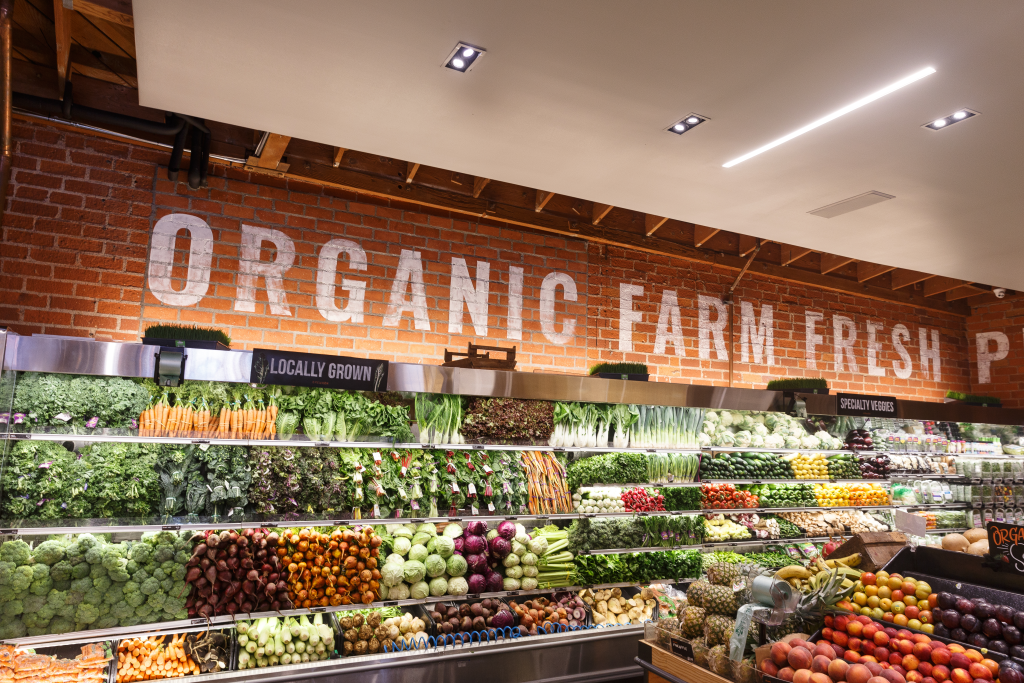
Erewhon was founded in 1966 in Boston by Michio and Aveline Kushi as one of America’s first natural food shops. Macrobiotic, organic, granola-era health food. The name comes from Samuel Butler’s 1872 novel “Erewhon,” an anagram of “nowhere,” about a utopia where people are responsible for their own health.
The LA location opened in 1969 on Beverly Boulevard. For decades it was a small, quiet health food store. Not famous. Not trendy. Not a destination.
In 2011, Tony and Josephine Antoci bought the single remaining LA store. Tony had previously owned Superior Anhausner Foods, which he sold to Sysco in 2009. He understood food distribution, margins, and operations. What he built at Erewhon was something different: a grocery store that functions as a luxury brand.
Second location: Calabasas, 2014. Then Pasadena, Culver City, Santa Monica, Studio City. By 2023, ten locations. In 2025, three more opened (Manhattan Beach, West Hollywood, Glendale). National expansion into 20 cities announced, with New York “absolutely on our radar” per Antoci.
The $30 million investment in a 65,000-square-foot commissary kitchen in Vernon, California quintupled production capacity for prepared foods and juices. Antoci called it “the engine of the business.”
💡Strategy Playbook: Treat your store as a media channel. The products are content. The launches are episodes. The customers are the distribution.
The play
1. Celebrity smoothies are marketing campaigns that generate revenue instead of costing money
The first celebrity smoothie collab was with influencer Tinx in 2021. Then Marianna Hewitt (co-founder of Summer Fridays skincare). These were small. The format was proven but nobody was paying attention yet.
Hailey Bieber changed everything in 2022. The Strawberry Glaze Skin Smoothie, launched alongside her skincare brand Rhode, went viral. Erewhon’s EVP Vito Antoci told Highsnobiety the store sells about 40,000 Bieber smoothies per month across its locations. At $19 each, that’s roughly $760,000 in monthly revenue from a single menu item.
The collab structure (based on public reporting, Erewhon hasn’t confirmed specifics):
→ Celebrity co-develops a recipe with Erewhon’s team → Erewhon sources ingredients from brands that sometimes pay for inclusion (ingredient placement, similar to product placement in films) → Celebrity promotes the launch to their audience (Bieber has 55M+ Instagram followers) → Erewhon gets foot traffic, social media content, and smoothie revenue → Celebrity gets a revenue share from smoothie sales plus promotion for their own brand → Ingredient brands get placement and visibility
Everyone gets paid. Nobody pays for advertising. The marketing campaign IS the product.
Traditional grocery marketing: spend money on ads to get people into the store. Erewhon’s model: launch a product that celebrities promote for free because it promotes their brand too. The marketing generates revenue instead of consuming it.
Kourtney Kardashian’s Poosh Potion. Olivia Rodrigo. Sabrina Carpenter. Emma Chamberlain (who also has Chamberlain Coffee stocked on Erewhon shelves). Each launch follows the same playbook: limited-time availability, social-first announcement, in-store exclusivity. Bieber’s smoothie was so successful it became a permanent menu item.
2. The store is the content studio
Erewhon doesn’t need to create marketing content. Its customers do it for free. The store is designed to be photographed and filmed.
→ The interior is minimal, bright, and aesthetically consistent (think Aesop or Glossier, not Kroger) → The smoothie cups are branded and photogenic → The hot bar plates look like restaurant dishes, not cafeteria food → The product curation is unusual enough to generate “look what I found at Erewhon” content
“What I got at Erewhon” is a TikTok content genre. People film their hauls, their smoothie orders, their hot bar plates. Micro-influencers and macro-influencers both post Erewhon content organically because the store signals a certain lifestyle. Carrying an Erewhon bag or smoothie cup is a visible marker (in LA, at least) of wellness, wealth, and cultural awareness.
The store doesn’t just sell products. It sells status. And status is inherently shareable.
This is the dynamic most grocery chains can’t replicate. A Whole Foods haul video isn’t cultural content. A Trader Joe’s haul is cozy and relatable. An Erewhon haul is aspirational. The price point, the curation, and the celebrity association create an aspirational gap that drives content creation.
3. The membership program turns status into recurring revenue
50,000 people pay $100-200/year for Erewhon membership. Benefits include special pricing on products, free drinks, and access to a “lifestyle collective” of discounts from partner brands (resorts, fitness studios, wellness companies).
The membership does three things:
→ Recurring revenue independent of store traffic → Lock-in (if you’ve paid $200 for annual membership, you’re shopping at Erewhon, not Whole Foods) → Identity reinforcement (being an Erewhon member is a statement about who you are, similar to how an Equinox membership signals something beyond “I want to work out”)
The lifestyle collective is particularly clever. Erewhon partners with luxury wellness brands to offer member discounts, which means those brands are paying Erewhon for access to its customer base. The membership isn’t just a loyalty program. It’s a distribution channel for premium wellness brands to reach affluent, health-conscious consumers.
The payoff
The question every executive in the room would debate: can Erewhon scale beyond LA?
The brand is deeply, structurally tied to Los Angeles culture. Celebrity sightings in-store. The smoothie collabs are LA-native celebrities. The aesthetic is LA wellness. The customer base is LA affluent. The stores are LA-designed adaptive reuse spaces.
Erewhon announced expansion into 20 US cities: Manhattan, Miami, San Francisco, Chicago, Nashville, Phoenix, Dallas, and more. Three new LA locations opened in 2025. National rollout is the stated plan.
The precedents go both ways:
→ Whole Foods scaled from Austin. Started as a single health food store in 1980. Went national. Sold to Amazon for $13.7B in 2017. Proof that premium organic grocery can travel. → Trader Joe’s scaled from LA. Started as a single store in Pasadena in 1967. Now 560+ locations. Proof that a quirky, curated grocery concept with cult loyalty can expand nationally. → Dean & DeLuca failed. Started as a premium specialty food store in NYC. Expanded too fast. Filed for bankruptcy in 2020. Proof that premium food retail can collapse when it scales beyond its core customer.
The arguments for Erewhon scaling: → Wellness culture is national, not just LA. The $19 smoothie customer exists in every wealthy zip code. → The celebrity collab model travels. Hailey Bieber has fans in Nashville and Miami, not just Beverly Hills. → The commissary kitchen investment ($30M, 65K sqft) was specifically built to support multi-city production.
The arguments against: → $1,800/sqft revenue depends on a specific density of affluent, wellness-obsessed, socially active customers. Does that density exist in Glendale the same way it does in Silver Lake? → The “be seen at Erewhon” social dynamic is LA-specific. In NYC, the equivalent signaling behavior happens at different places (Cha Cha Matcha, certain Equinox locations, specific restaurants). Erewhon would need to build that cultural position from scratch in each new city. → The smoothie collabs generate viral content partly because they’re exclusive to a small number of locations. If there are 50 Erewhons across 20 cities, the exclusivity dilutes. The scarcity that drives demand is a function of limited availability. → They filed an environmental lawsuit to block affordable housing development near their Studio City location. That’s the kind of story that hits differently in cities where the brand doesn’t have established goodwill.
The honest answer is that nobody knows yet. The LA model is proven. The national model is unproven. The 2025-2026 expansion will provide the data. If Manhattan Beach and West Hollywood perform at $1,800/sqft, it validates the model outside core LA neighborhoods. If they don’t, the ceiling might be 15-20 locations in Southern California, which is still a very profitable business, but a different story than “the next Whole Foods.”
Further reading
How an Erewhon celebrity smoothie is born (Highsnobiety, 2024) ↗ The inside mechanics. 40,000 Bieber smoothies/month, the revenue math, ingredient brand placement, and why the economics work for everyone involved.
Erewhon 2.0 expansion (Progressive Grocer, July 2025) ↗ Three new stores in 2025, national expansion plans, the commissary kitchen investment, and Tony Antoci’s vision for scaling beyond LA.
Erewhon’s influencer marketing strategy (Nowfluence, 2025) ↗ The collab timeline from Tinx (2021) through Sabrina Carpenter (2025). How organic content from micro-influencers compounds on top of official celebrity launches.
I was suggested this web site by my cousin. I am not sure whether this post is written by him as nobody else know
such detailed about my difficulty. You’re incredible! Thanks!
Nice blog here! Also your site loads up very fast! What host are you using?
Can I get your affiliate link to your host? I wish my website loaded up as
fast as yours lol