
Chewy does basically the same thing Pets.com did. Sells pet supplies online. Made $11.9B in revenue last year. So either Pets.com was a good idea at the wrong time, or Chewy figured out something Pets.com didn’t. Probably both.
In its first operating year, Pets.com earned $619,000 in revenue and spent $11.8 million on advertising. Nineteen dollars out for every dollar in. And that was just marketing. Product costs, shipping, warehouse, engineers, all separate. The S-1 filing disclosed every bit of this. Investors could have read it. In early 2000, with the Nasdaq at 5,000 and climbing, apparently nobody felt like reading.
They IPO’d on February 1, 2000. Stock opened at $11. Touched $14 briefly. By November 7 they announced they were shutting down. Stock at $0.19. The whole run as a public company lasted 268 days.
Sponsored by HubSpot

🤖 Turn AI into Your Income Engine! 🚀
Ready to transform artificial intelligence from a buzzword into your personal revenue generator? Our groundbreaking guide “200+ AI-Powered Income Ideas” is your gateway to financial innovation in the digital age.
Inside you’ll discover:
- A curated collection of 200+ profitable opportunities spanning content creation, e-commerce, gaming, and emerging digital markets—each vetted for real-world potential
- Step-by-step implementation guides designed for beginners, making AI accessible regardless of your technical background
- Cutting-edge strategies aligned with current market trends, ensuring your ventures stay ahead of the curve
Access your guide now and join thousands of forward-thinkers already capitalizing on AI’s potential.
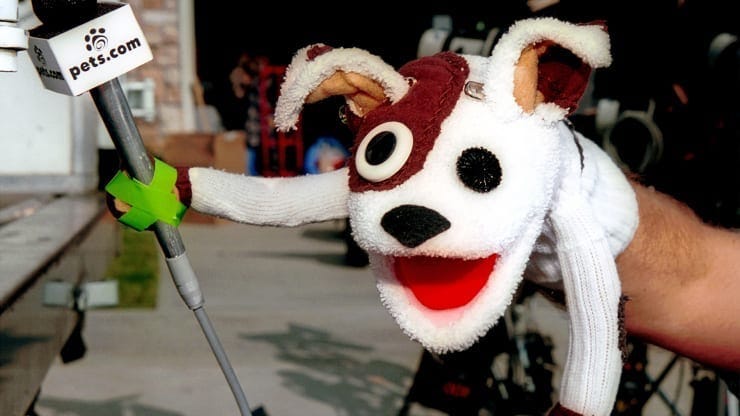
Greg McLemore was a domain speculator. He’d accumulated names like Sports.com and Ask.com, flipping them or trying to build businesses on top of them. Pets.com was one of those bets. By 1998 it was a real company, shipping pet food and supplies from a warehouse in San Francisco. The pitch was straightforward: pet owners buy heavy, bulky stuff on a regular schedule. 40-lb bags of dog food. Cases of cat litter. Hauling it home from PetSmart is annoying. Deliver it to their door.
Jeff Bezos liked the idea enough to put in $50M for a 54% stake. Additional VC from Hummer Winblad. Then an IPO that raised $82.5M through Merrill Lynch. Total capital across all rounds: roughly $300M.
Julie Wainwright was the CEO brought in to scale it. Her first move tells you a lot about the era. At her previous company, Reel.com (online DVD sales), she’d been buried by Amazon entering the category. So when she took over Pets.com, she immediately sought Amazon’s investment. “The opportunity just got significantly less risky with Amazon in as a partner, not a competitor,” she said at the time. Get Bezos on your side before he decides to compete with you.
It worked, in the sense that Amazon wrote the check. But Pets.com wasn’t a conviction bet for Bezos. Amazon was simultaneously investing in Kozmo.com (1-hour delivery), Gear.com (sporting goods), Wineshopper.com, Homegrocer.com, and Greenlight.com. Spray and pray across categories. If online pet supplies took off, Amazon had a 54% stake. If it didn’t, the loss was manageable relative to Amazon’s ambitions. Pets.com treated the Amazon partnership as validation. Amazon treated it as an option.
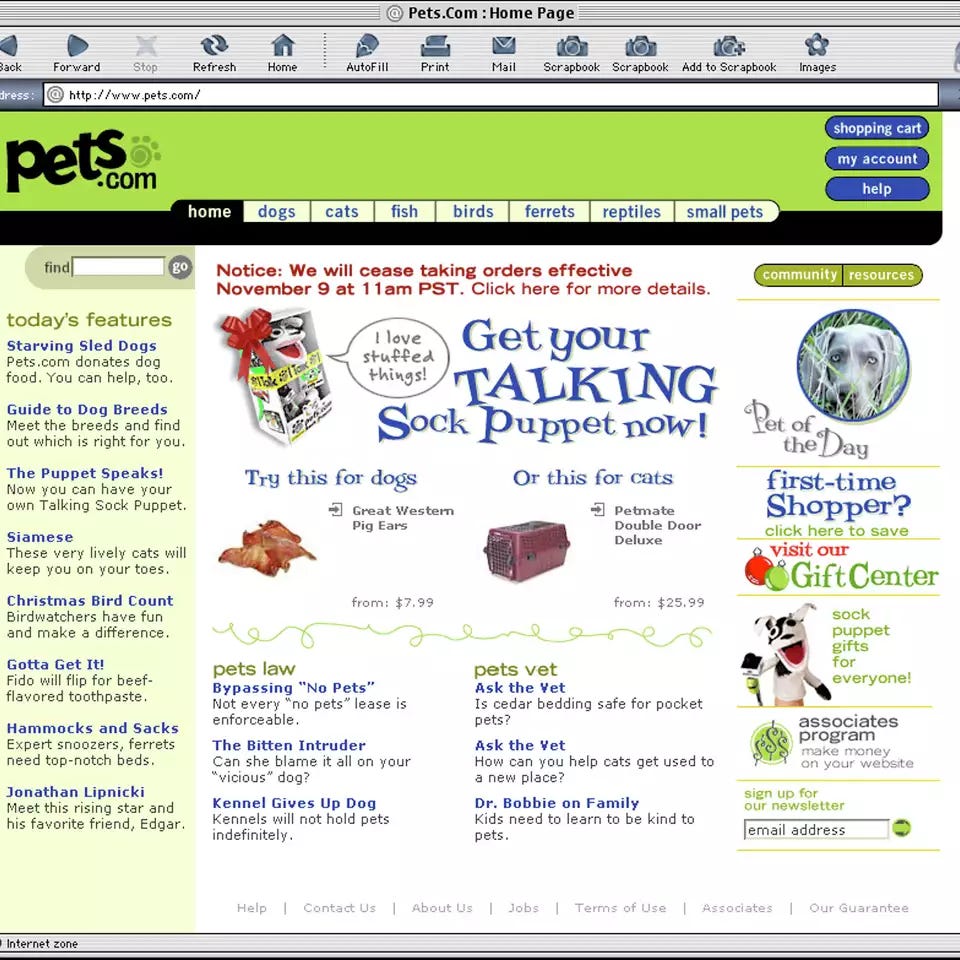
Pets.com became the poster child for the crash because the math was so obviously wrong. Over its entire lifespan, the company spent $46 million buying products and sold them for $31.5 million. They lost money on the product itself before a single box was shipped. Then they shipped 40-lb bags of dog food across the country for free. Then they spent $400 acquiring each customer who placed those money-losing orders.
And they weren’t alone. That’s the part most people leave out. Petopia.com raised $124M. PetStore.com raised tens of millions more. PetPlanet.com entered the market. PetSmart.com launched its own competing site. Five funded companies, all going after the same $23B US pet supply market, all burning cash to outspend each other on customer acquisition. McLemore himself blamed the “stupid competitors” for turning a category into an arms race nobody could win.
The plan, at every one of these companies, was the same: acquire customers at a loss, build a massive user base, then gradually raise prices once customers are locked in. Pet owners are habitual buyers. Once they’re ordering from you every month, they won’t bother switching back to the store. Classic land-and-expand logic. Sounds reasonable if you don’t look at the numbers.
The numbers: $400 CAC against a customer lifetime value that was nowhere close. Free shipping on items that cost $8-12 to deliver. And delivery times of 8-10 days, which in 1999 meant the customer could just buy the dog food on the way home from work three times before the online order even showed up.
There was no switching cost. A Pets.com customer could drive to PetSmart tomorrow and nothing about their life would change. No subscription tying them down. No saved preferences that took time to rebuild. No ecosystem lock-in. Just a website and a sock puppet.
The marketing worked though. The sock puppet became a cultural moment. People talked about it. Brand awareness went through the roof. The puppet was in the Macy’s Thanksgiving Day Parade (first dot-com to do that), interviewed by People magazine, featured on Good Morning America and Live with Regis and Kathie Lee. If you judge the campaign purely on “did people hear about Pets.com,” it was one of the most successful ad campaigns of 2000.
But awareness without positive unit economics just means more people know about a way to lose money faster. Every new customer the sock puppet attracted cost $400 to acquire and generated negative gross margin on their orders. The better the marketing worked, the faster the company burned through its cash.
VC investment in tech dropped from over $100B in 1999 to under $30B in 2000. That 70% collapse happened right when Pets.com needed another round. By Q4 2000 they had $23M in cash, maybe one quarter of operations left. Merrill Lynch tried to find a buyer. Nobody was interested. Petopia sold to Petco. PetStore.com had already sold its assets to Pets.com months earlier. The entire online pet category collapsed at once.
On November 7, 2000, Pets.com shut down. 320 employees lost their jobs.
One detail that gets reported wrong: Pets.com never filed for bankruptcy. Wainwright did an orderly liquidation, sold off the assets, and returned what she could to shareholders. PetSmart had offered to buy the whole company months earlier, but the offer was below net cash value, so the board turned it down. PetSmart ended up just buying the domain in December 2000 for a fraction of what the company had raised. The URL redirects to PetSmart.com to this day.
Five months before shutting down, Pets.com had acquired PetStore.com for $10.6M. Still spending money they didn’t have on consolidation in a market that was already collapsing underneath them.
And here’s the part about Amazon that rarely gets mentioned: Bezos closed Amazon’s own funding round just one month before the 2000 crash. One month later and Amazon might have faced insolvency too. The difference between Amazon becoming a $2T company and joining Pets.com in the dot-com graveyard was about 30 days of timing. Bezos was smart. He was also lucky.
Wainwright later called herself “sort of a pariah.” She went on to found The RealReal (luxury consignment, IPO’d 2019), which is worth remembering when people use her name as shorthand for failure.
The sock puppet’s rights were bought by a subprime auto lending company in Virginia called Bar None. They put it in TV ads helping people with bad credit get car loans. The puppet “survived the dot-com bust.” Wainwright cried when she saw it. The mascot outlived the company by decades. The domain redirects to PetSmart.com now.
Ryan Cohen and Michael Day started Chewy in 2011. Online pet supplies. Delivered to your door. Subscribe and save for recurring orders. The pitch was almost word-for-word Pets.com’s pitch from 1998.
What changed between 1999 and 2011:
- Shipping got cheap. FedEx and UPS ground networks expanded massively. Delivering a 40-lb bag of dog food went from prohibitively expensive to manageable. Last-mile infrastructure that Pets.com needed simply didn’t exist at scale in 1999.
- People stopped being afraid of buying things online. By 2011, Amazon had trained a generation to expect delivery. The behavioral shift had already happened. In 1999, entering a credit card number on a website still felt risky.
- Subscription models were proven. Dollar Shave Club, Amazon Subscribe & Save showed recurring delivery of consumables could create sticky revenue. Chewy’s Autoship program now accounts for ~78% of revenue. Pets.com had to convince people to come back and reorder manually every time.
- Digital marketing replaced broadcast. Chewy targeted pet owners through Facebook and Google instead of $1.2M Super Bowl ads aimed at 130 million people who mostly didn’t have pets. CAC dropped from $400 to something the margins could support.
- Delivery got fast. 8-10 days in 1999 vs 1-2 days by the 2010s. That’s the difference between “I’ll just buy it at the store on the way home” and “it’ll be on my doorstep before I run out.”
- Fulfillment automation existed. Chewy operates 30+ fulfillment centers with automated picking and packing. The warehouse technology to ship pet supplies efficiently at scale didn’t exist in 1999.
PetSmart acquired Chewy in 2017 for $3.35B, the largest ecommerce acquisition at that time. IPO in 2019. Fiscal 2025 revenue: $11.9B. Net income positive. The company is profitable.
Hundreds of companies failed in the dot-com crash. Webvan (grocery delivery, died 2001) preceded Instacart by 12 years. Kozmo.com (1-hour delivery in Manhattan, died 2001) preceded DoorDash and Gopuff by about 15 years. Not dumb ideas from dumb people. Ideas that needed a world that hadn’t been built yet.
- How do you tell the difference between “too early” and “wrong”? Pets.com’s investors couldn’t have known in 1999 that shipping costs would drop enough to make online pet supply delivery viable by 2011. The infrastructure wasn’t on a predictable timeline. You can see that ecommerce will grow, but you can’t see exactly when FedEx Ground will get cheap enough to ship cat litter profitably. If your business depends on infrastructure that doesn’t exist yet, you’re not building a company. You’re placing a bet on when that infrastructure shows up. And you’re using other people’s money to stay alive until it does.
- Would Pets.com have survived with less spending? If Wainwright had burned through the $300M more slowly, kept the company alive until 2005 or 2006, the infrastructure might have caught up. But that’s not how venture-backed companies operated in 1999. The expectation was grow fast, grab share, figure out profitability later. And with five competitors all burning money in the same category, slowing down meant losing the land grab. The $300M wasn’t mismanaged as much as it was spent according to the consensus logic of the era. That logic was wrong. But everybody at every VC firm and every dot-com board believed it at the time.
- Why did Pets.com become THE symbol when hundreds of companies died? The sock puppet. The company spent a fortune creating a mascot so memorable that it permanently attached the name “Pets.com” to the word “failure.” If they’d run boring banner ads instead, nobody would remember the company. The advertising that was supposed to make Pets.com unforgettable succeeded. Being unforgettable just turned out to be a curse when the thing people remembered was how spectacularly you failed.
Further reading
- Why Pets.com actually failed: the $300M sock puppet disaster (404 Memory Found, March 2026): The most detailed financial breakdown. $619K revenue vs $11.8M advertising. IPO to liquidation in 268 days. The sock puppet’s second life at a subprime auto lender.
- Why Did Pets.com Fail? Setting the Record Straight (Startup Stumbles, 2023): The competitor angle. Petopia ($124M raised), PetStore.com, PetPlanet.com. Five funded companies in the same arms race. McLemore blaming “stupid competitors.”
- The Sock Puppet That Kept Pets.com Alive
- Lessons from the Pets.com downfall: bad idea or good idea that was early? (Begin to Invest): The Chewy comparison. Why the same concept works 20 years later. What changed in shipping, consumer behavior, and fulfillment technology.
That’s all for today. I’m going to go stare at my laptop and pretend I’m thinking strategically. See you Friday.
Leave a Reply