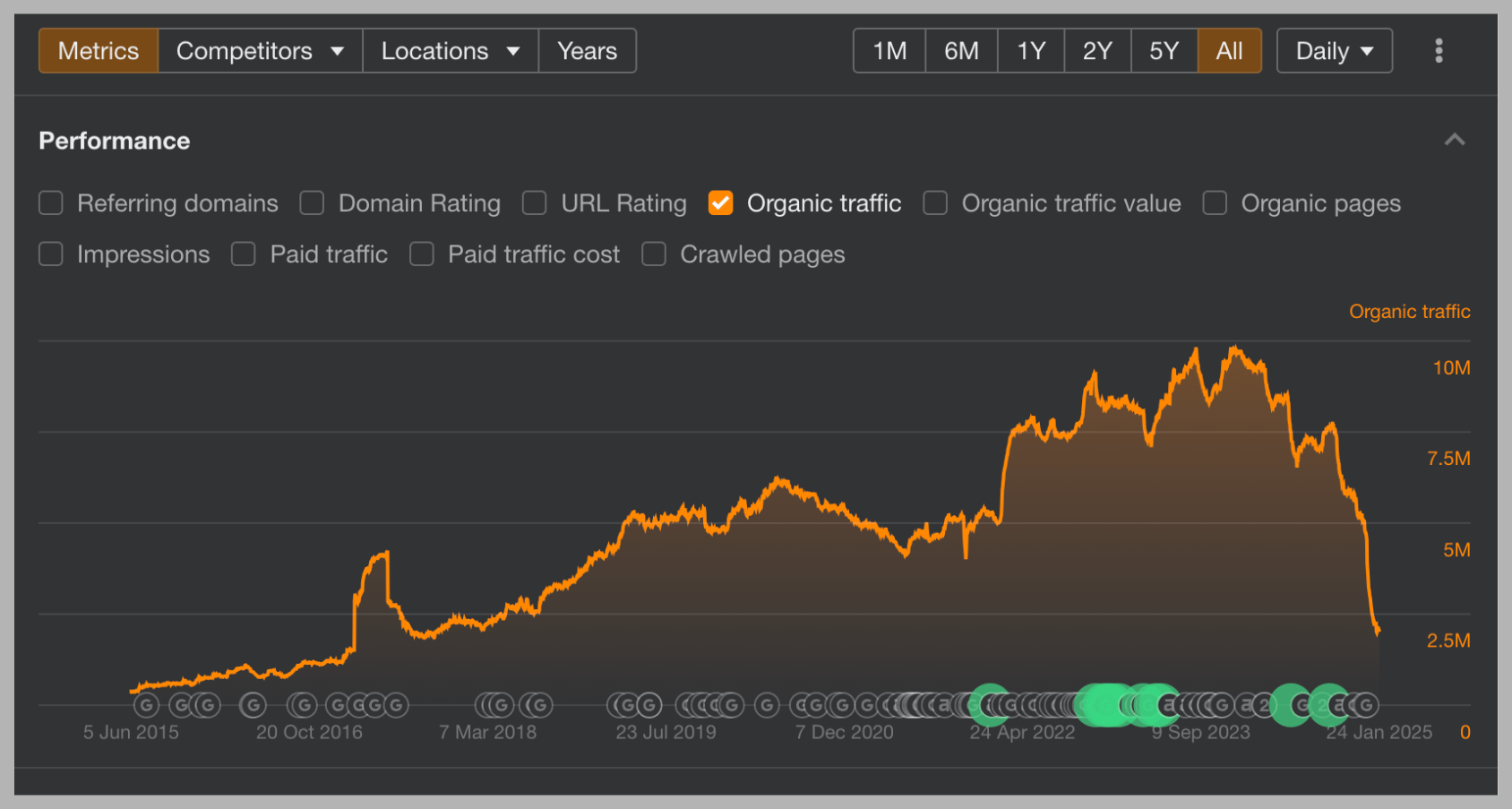
In March 2023, HubSpot was pulling 24M organic visits a month. By January 2025 that number was 6M. A 75% drop. Gone.
The same year that happened, HubSpot posted $3.13B in revenue, up 19%. Customer count grew to 288,706, up 16%. GAAP operating income hit $7.4M after a $67.6M operating loss the year before. Operating cash flow came in at $760.7M, their best year on record. Two weeks after the Starter Story deal closed, the board authorized a $1B share buyback.
Traffic down 75%. Business up everywhere that matters.
Most people read it as "HubSpot survived an SEO collapse." What actually happened is more interesting: the replacement channel was already working before the crisis arrived.
The Future of AI in Marketing. Your Shortcut to Smarter, Faster Marketing.
Unlock a focused set of AI strategies built to streamline your work and maximize impact. This guide delivers the practical tactics and tools marketers need to start seeing results right away:
7 high-impact AI strategies to accelerate your marketing performance
Practical use cases for content creation, lead gen, and personalization
Expert insights into how top marketers are using AI today
A framework to evaluate and implement AI tools efficiently
Stay ahead of the curve with these top strategies AI helped develop for marketers, built for real-world results.
What the blog actually was
For about a decade, HubSpot ran one of the most aggressive content programs in B2B software history. At peak they had 18,000+ blog posts. The strategy was volume and reach, not conversion. They ranked for shrug emojis, famous quotes, resignation letter templates, cover letter examples. Stuff that had nothing to do with CRM software. At that scale, SEO becomes a brand play. If Google search is a billboard, HubSpot was on every billboard.
It worked. For years. The traffic built brand awareness, the brand awareness drove trial, trial drove conversion. The funnel was long and indirect but it ran.
Then Google changed what it rewards. The December 2024 core update hit sites with off-topic content hardest. AI Overviews started answering informational queries directly, killing the click-through on exactly the kind of generic content HubSpot had built its traffic on. Famous quotes. Sales slogans. Stuff a language model can answer without sending you anywhere.
The blog subdomain lost 81% of its traffic per SurferSEO tracking. The shrug emoji post, which was doing 200K monthly visits as recently as mid-January 2025, quietly disappeared. It now redirects to a post about content audits.

HubSpot's CMO Kipp Bodnar wrote a post acknowledging what happened, and to his credit it's more honest than most corporate responses to bad news. His framing: Google's recent algorithm updates "added new urgency" to a shift that was already underway. That phrase is doing a lot of work. It tells you the pivot was real, and that the timeline got accelerated from outside. Both things can be true.
The chess move they made before any of this
In February 2021, HubSpot acquired The Hustle for a reported $27M. The deal came with 1.5M newsletter subscribers and My First Million, the podcast Sam Parr and Shaan Puri had built for the entrepreneurship and operator audience.
That was four years before the traffic collapse.
Bodnar names The Hustle specifically in his post as part of a deliberate push to transform HubSpot's content "from largely informational into an ever-present part of our target customers' lives." That's not spin after the fact. The Hustle acquisition was 2021. The strategy was already being named before the blog fell apart.
Later they added Mindstream, an AI-focused newsletter with 210K subscribers built in under 18 months. In February 2026, two weeks after the Q4 earnings call, they closed Starter Story. Pat Walls, his sister Sam Walls who ran operations, and their producer Gus Tiffer all joined HubSpot Media. Starter Story had 800K YouTube subscribers, 275K newsletter subscribers, and 1.6M total audience. Seven figures in revenue, 75% of it from owned products: subscriptions, courses, a paid community of 10K+. The whole thing ran as a team of three.
Pat Walls had publicly talked about pitching a deal on X in June 2025. He wasn't hiding it. He wanted the infrastructure. HubSpot wanted the audience. Walls put it simply when the deal closed: HubSpot understands distribution. They believe in the builders.
Combined, HubSpot's YouTube network is now at 2.9M subscribers per their own figures, more than Morning Brew and roughly double Salesforce's YouTube presence. Their $87.6M in business acquisitions in 2025 was double what they spent in 2024. They didn't stumble into a media strategy after the SEO collapse. They spent four years and an accelerating acquisition budget building one.
Why this works mechanically
Here's the thing about the HubSpot blog at peak traffic: almost none of it was catching buyers. The person Googling "famous quotes" is not in the market for a CRM. They're killing five minutes. HubSpot was reaching a massive audience of people who would never buy anything from them, paying for that reach through content production costs and hoping some small percentage converted.
The media properties work differently. The Hustle reader is an operator, a founder, someone building a company. They're reading about funding rounds, hiring decisions, growth tactics. They're not in market for a CRM today. But in 12 months when they hit 20 employees and someone says they need to get their sales process in order, HubSpot is already inside their head.
Bodnar explained the goal directly: when people eventually need a product HubSpot sells, "they come to us first." That's demand creation, not demand capture. You're not catching people at the moment of purchase intent. You're shaping who they think of before they even know they're in the market.
There's a RockWater analysis that framed this well: for a founder, a CRM is a late-stage utility. A case study on growth tactics is an early-stage necessity. HubSpot buying Starter Story means they own the media a founder consumes before they ever think about software.
The financial mechanics reinforce it. Average B2B paid search CAC hit $802 in 2025. Mid-market SaaS runs $1,200 to $2,000 per customer through paid channels, and that number is up 40 to 60% since 2023. HubSpot's average subscription revenue per customer was $11,683 in Q4 2025, up 3% year over year. Fewer, more valuable customers, growing revenue. The media strategy isn't just replacing lost blog traffic. It's pulling in buyers who already trust the brand before sales ever touches them.
There's also a detail in the 2025 10-K that most coverage missed: roughly 49% of HubSpot's revenue runs through Solutions Partners, with about 25% of customers coming through that channel. Most of the business never depended on search traffic to begin with. The blog was the loudest part of their marketing story, not the biggest driver of their revenue.
Go from AI overwhelmed to AI savvy professional
AI will eliminate 300 million jobs in the next 5 years.
Yours doesn't have to be one of them.
Here's how to future-proof your career:
Join the Superhuman AI newsletter - read by 1M+ professionals
Learn AI skills in 3 mins a day
Become the AI expert on your team
The LLM angle
While Google traffic fell, something else happened. Bodnar says HubSpot's traffic from LLMs is increasing. The same content that gets fewer Google clicks is showing up more inside ChatGPT answers, Perplexity results, AI Overviews. He gives a specific example: a colleague using ChatGPT to research DeepSeek got served a link to a HubSpot video as a primary result.
This matters because it shows the distribution moat has a dimension beyond owned newsletters and YouTube. High-quality, expertise-driven content gets cited by AI systems. Generic informational content gets replaced by them. HubSpot's off-topic blog posts were exactly the kind of content AI Overviews were built to kill. Their creator-driven, founder-focused media properties are exactly the kind of content AI systems treat as credible sources.
Bodnar also notes transactional search, people looking for specific products and solutions, held up and actually grew. The traffic that matters for conversion never collapsed. What collapsed was the massive top-of-funnel brand play that was never really converting anyway.
HubSpot isn't the only one doing this
The pattern is showing up across SaaS. Semrush acquired Backlinko in 2022. Zapier acquired Makerpad in 2021. Pendo acquired Mind the Product in 2022. Mailchimp built Courier Magazine. AngelList bought Product Hunt in 2016 before anyone was calling it a media strategy.
The underlying logic is the same everywhere: you can't buy your way to a trusted relationship with your customer using paid channels, and organic search is getting less reliable as AI absorbs informational queries. What you can do is acquire the media brands your customers already trust and let that trust transfer.
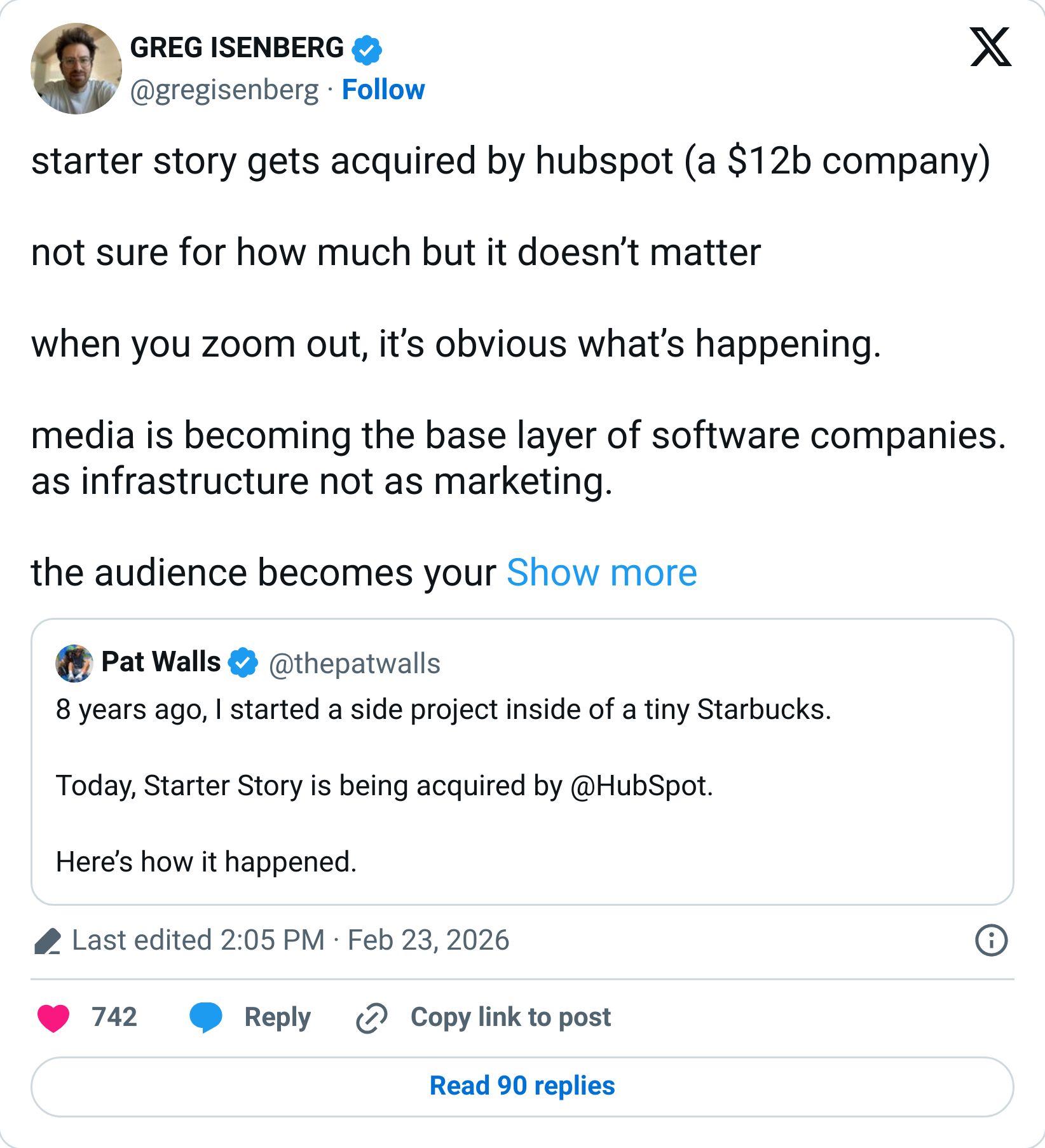
Greg Isenberg put a version of this into words on X: media is becoming the base layer of software companies, not as marketing but as infrastructure. The audience becomes your research lab, distribution engine, recruiting funnel, feedback loop, and launchpad.
That's a cleaner way to say what HubSpot is actually doing. They're not running a content marketing strategy. They're building infrastructure.
What the numbers tell you
HubSpot spent $87.6M acquiring businesses in 2025, up from $40.4M the year before. The year their blog collapsed, they doubled their acquisition spend. The year their Google traffic hit 6M, they generated $594.9M in free cash flow. The year the SEO model broke, they swung from a $67.6M operating loss to $7.4M operating income.
None of that is luck. The Hustle acquisition in 2021 predates the Google algorithm changes by three years. Bodnar confirmed it was a deliberate move toward influence-over-information before the crisis. The crisis just removed any remaining ambiguity about whether the old model was still viable.
Note: HubSpot separately claims YouTube-driven leads are up 68% year over year and newsletter leads up 53%, with 50M+ monthly engagements. These figures come from HubSpot's own press materials around the Starter Story deal and aren't in audited financials. The revenue, cash flow, and acquisition spend numbers are from their Q4 2025 earnings release filed with the SEC.
Most companies in HubSpot's position would have spent 2024 and 2025 trying to recover the traffic. SEO fixes, content refreshes, technical audits. Trying to get back to 24M.
HubSpot spent it buying the audiences their potential customers were already in. By the time Google finished restructuring how it handles informational queries, HubSpot had already built a distribution network that doesn't depend on Google.
The blog traffic is probably not coming back. The business doesn't need it to.
Why this matters if you're not HubSpot
Founder-focused newsletter space is crowded now vs three years ago. B2B YouTube is earlier but filling up. Podcasts are saturated. Every format compresses as more people figure out the same playbook. The window's still open. Just not as wide as it was.
The thing about distribution you build—newsletter, YouTube, podcast, community, whatever format actually fits your buyer—is it compounds. Every issue you send, every video you post, is a permanent asset. The audience you have in 18 months is a function of what you start building today, not what you spend next quarter.
The format almost doesn't matter. What matters is whether your buyer actually engages with it, and whether you're building something direct—something that doesn't disappear if an algorithm changes or an ad platform raises prices.