
Before we begin… a huge thank you to this week’s sponsor.
Stop guessing, start listening continuously.
In a world that’s constantly changing, the best decisions come from data that’s current, connected, and grounded in real feedback from real people.
Built for teams with “full plates” (and zero time), SurveyMonkey programs make it simple to transition from the one-off survey to a continuous feedback loop.
Instead of starting with a blank page, you get a built-in roadmap informed by 25+ years of survey expertise. Programs suggest how often surveys should be sent and let you see how sentiment evolves over time, so your metrics finally have context.
No more stale snapshots. Run feedback programs that power smarter decisions.
Before COVID, Brian Chesky ran Airbnb like everyone told him to. Hired experienced executives. Gave them divisions. Let them operate independently. The standard Silicon Valley playbook for scaling past the founder stage. “Hire great people and get out of their way.”
It wasn’t working. Different teams built different things with different priorities. Nobody knew what anyone else was shipping. The product felt scattered. Chesky felt disconnected from the work. But he kept doing it because that’s what every advisor, board member, and business book told him to do. The founder’s job is to delegate.
Then in March 2020, Airbnb’s revenue dropped 80% in eight weeks. Travel stopped globally. The company was burning cash. Chesky laid off 25% of staff.
And instead of just cutting costs and waiting for recovery, he used the crisis to completely restructure how Airbnb operates. He went to his friend Jony Ive, Apple’s former chief design officer, and asked for advice. Ive connected him with Hiroki Asai, Apple’s former creative director. Together they walked Chesky through how Steve Jobs ran Apple.
What Jobs did when he returned to Apple in 1997 (90 days from bankruptcy at the time): killed most product lines, eliminated the divisional structure, moved to a single functional organization, and personally reviewed everything before it shipped.
Chesky did the same thing at Airbnb. And the term Paul Graham later used to describe this approach became one of the most debated ideas in Silicon Valley: founder mode.
The setup
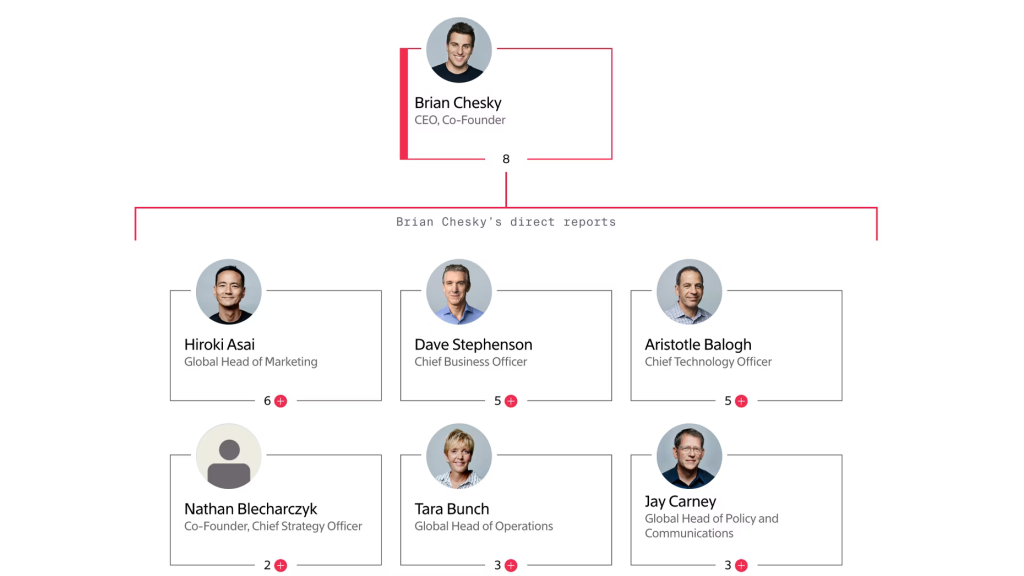
The pre-COVID Airbnb had a divisionalized structure. Homes was one division. Experiences was another. Luxury (later Airbnb Plus) was another. Each division had its own product managers, engineers, designers, and marketing people. They operated like mini-companies inside the company.
The problem with divisional structures at tech companies:
→ Each division optimizes for its own metrics, not the overall product
→ Duplicated roles across divisions (you need PMs, engineers, designers for every division)
→ No shared roadmap. Division A ships something that contradicts what Division B just shipped.
→ The CEO becomes a capital allocator reviewing business unit P&Ls, not a product leader making decisions about what to build
→ The product drifts because nobody is making holistic design choices across the whole experience
Chesky described it later: well-meaning people told him to hire experienced executives and let them run their divisions. He did. And the company started feeling like “a conglomerate, not a startup.”
The pandemic forced the question. With revenue down 80% and a quarter of the staff gone, there wasn’t enough headcount to maintain separate divisional teams. The crisis gave Chesky permission to restructure in ways that would have been politically impossible during growth.
💡When a company feels slow and scattered, the org chart is usually the problem, not the people.
Breakdown
1. Functional org + one roadmap = the Jobs model
Chesky eliminated Airbnb’s divisional structure and moved to a functional organization. Instead of each division having its own engineering, design, and product teams, there’s now one engineering organization, one design organization, one marketing organization. All working on one shared roadmap.
The key changes:
→ One company-wide roadmap. Nothing ships unless it’s on the roadmap.
→ Chesky personally reviews every product release before it goes out
→ The top ~30 people in the company work on everything together. No swim lanes.
→ Designers elevated to equal status with (or above) product managers. Chesky said at Figma’s Config 2023: “We got rid of the classic product management function.” (He later clarified: they morphed it into an Apple-style product marketing function, not eliminated it entirely.)
→ Product launches happen on a cadence. Two major releases per year (summer and winter), announced at big events. Again, Apple’s playbook.
The functional model only works if the CEO is deeply involved in the product. In a divisional structure, the division heads own the product decisions and the CEO manages the portfolio. In a functional structure, the CEO IS the integrator. Every design, engineering, and marketing decision converges at the top because there’s no middle layer of division heads to absorb it.
This is why Chesky calls it “founder mode.” The founder has to be in the details. Not micromanaging every pixel, but understanding what’s shipping, why, and whether it coheres as one product experience.
2. “You don’t manage people. You manage the work.”
Jony Ive gave Chesky a piece of advice that changed how he thinks about management. The exact quote hasn’t been published, but Chesky has paraphrased it multiple times: “You don’t manage people. You manage the work.”
In the old model, Chesky managed division heads. The division heads managed their teams. Chesky’s relationship to the actual work was at least two layers removed. He was managing people who managed people who made the product.
In the new model, Chesky manages the work directly. He sits in product reviews. He looks at design mocks. He gives feedback on marketing copy. He treats about 50 employees as his direct reports, though the formal org chart is smaller. He personally participates in hiring decisions.
The YC talk in 2024 is where this became public. Chesky described how he’d been told by “well-meaning people” to hire experienced executives and let them run things. He did. It went badly. Not because the executives were bad, but because the structure created distance between the founder’s vision and the product. The executives optimized for their division’s KPIs. The product lost coherence.
Paul Graham was in the audience. He wrote the “Founder Mode” essay afterward. The essay argued that the conventional wisdom about scaling companies (hire professional managers, delegate, step back) might be wrong for founder-led companies. That founders who stay deeply involved in the work, like Jobs at Apple or Chesky at Airbnb, produce better outcomes than founders who follow the “hire adults and get out of the way” playbook.
The essay went viral. “Founder mode” became a meme. Every founder on Twitter started claiming they were in founder mode. The backlash was predictable: what about all the founder-CEOs who micromanaged their companies into the ground? What about the companies that only succeeded because professional managers took over from the founder?
Chesky later clarified at the Skift Global Forum: “I never called it founder mode.” Graham named it. Chesky’s actual point was narrower. Great leadership requires presence, not absence. The CEO should understand the product deeply enough to make integrated decisions across functions. That’s not micromanagement. It’s the job.
3. The product got better. Measurably.
The restructuring wasn’t just organizational. The product changed.
Before the restructuring, Airbnb’s app felt like it had been built by multiple teams who didn’t talk to each other. Because it had been. Different parts of the experience had different design patterns, different interaction models, different visual styles.
After the restructuring:
→ Consistent design language across the entire product
→ Coordinated launches twice a year (summer and winter) with everything tied together
→ Rooms relaunch in 2023 brought Airbnb back to its core identity (renting a room in someone’s home, not just entire apartments)
→ Co-host Network in 2024 addressed the biggest pain point for hosts (managing properties remotely) as a coordinated product + marketplace feature
→ Every release tells a story. Not “here are 50 random features.” More like “here’s a theme, and everything we built this cycle supports it.”
The cadenced release model is directly from Apple. Apple doesn’t ship random features throughout the year. They announce a set of coordinated updates at WWDC and in September, and everything launches together. Airbnb does the same thing now. It creates anticipation, press coverage, and a coherent narrative that individual feature drops don’t generate.
Chesky hired Hiroki Asai (Apple’s former creative director) to run marketing. Asai brought Apple’s approach to product storytelling: lead with the human benefit, show the feature in use, make the announcement feel like an event.
The payoff
The conventional wisdom about scaling companies says founders should hire professional managers, delegate, and step back. Chesky did that. It didn’t work. He reversed course, went back to being deeply involved in the work, and the company’s product improved.
But “founder mode” is a sample size of a few. Jobs at Apple. Chesky at Airbnb. Maybe Musk at SpaceX. There’s survivorship bias all over this.
Does founder mode scale beyond a certain company size? Airbnb has ~6,900 employees. Apple had ~150,000 when Jobs died. Jobs was famously involved in product details at Apple’s scale, but Apple also had an extremely experienced functional leadership team (Tim Cook, Jony Ive, Phil Schiller, Craig Federighi) who could execute without Jobs being in every meeting. Chesky managing 50 direct reports at ~7,000 employees is one thing. Does this work at 50,000 employees? 100,000? At some point the CEO can’t physically review everything. The question is where that ceiling is.
What happens when the founder leaves? Apple post-Jobs has been financially successful but widely criticized for lack of product vision. The functional organization that worked brilliantly under Jobs became directionless without him because it was designed around one person’s integrating judgment. If Chesky leaves Airbnb, does the functional structure hold? Or does it revert to divisional because nobody else can play the integrator role? The dependency on the founder is the structural weakness of founder mode.
Is this just micromanagement with better PR? Chesky insists he’s not micromanaging. He’s providing direction and ensuring coherence. But the line between “involved in the details” and “can’t let go” is blurry. Plenty of founders have destroyed companies by refusing to delegate. The difference might be taste. Jobs and Chesky (both designers by training) have the aesthetic judgment to make product decisions that improve the work. A founder without that judgment who insists on reviewing everything before it ships would be a bottleneck, not an asset. Founder mode might only work for founders who are genuinely good at the work they’re reviewing.
Further reading
- Airbnb CEO nixed fiefdoms to survive pandemic. It worked better anyway. (Fortune, Sept 2023) ↗ The restructuring story. Divisional to functional. One roadmap. Jobs’ playbook applied to a travel marketplace.
- Founder Mode (Paul Graham, Sept 2024) ↗ The essay that named the concept. Why the standard advice to “hire good people and give them room” might be wrong. Written after watching Chesky’s YC talk.
- Airbnb CEO Brian Chesky on what founder mode really means (Decoder, Oct 2024) ↗ Chesky’s own clarification. “I never called it founder mode.” What presence vs absence means for leadership. The difference between micromanagement and integration.
→ How many layers sit between you and the work your company ships? Every layer adds coordination cost and removes context. Chesky’s answer was to remove the layers entirely. The question is whether your company can survive the transition.
Leave a Reply